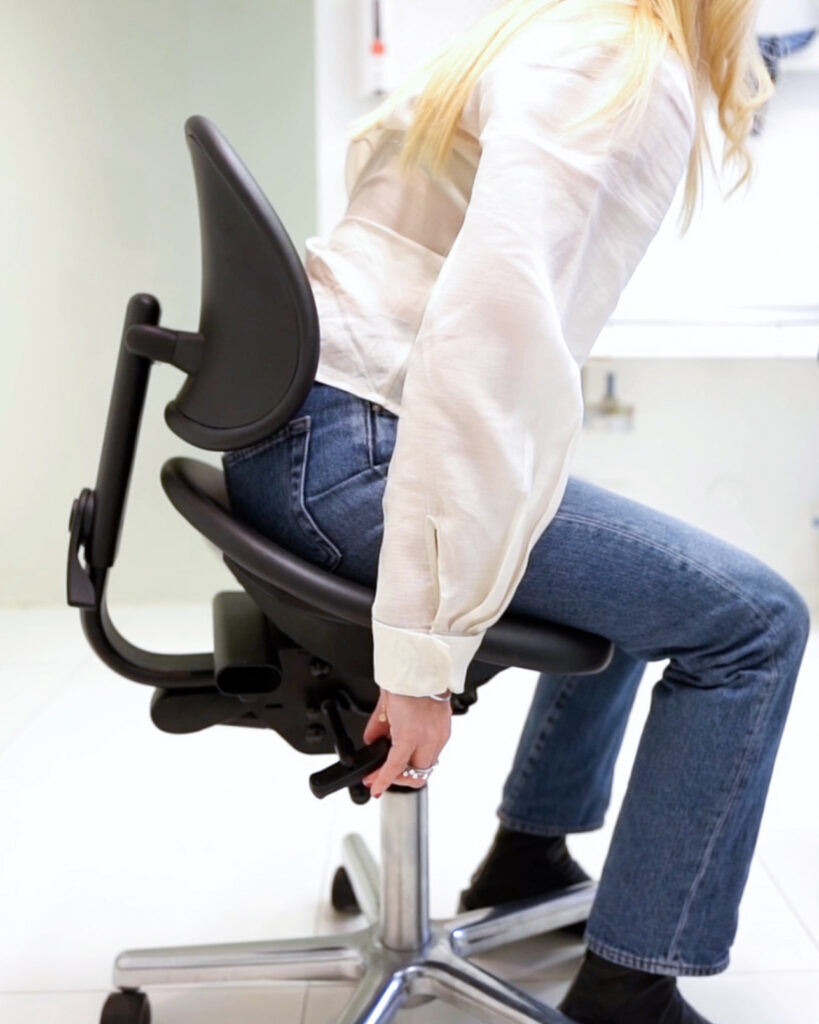
A lot of research has been done on our spine because it is such an incredibly important and complex part of our well-being. A scientific study conducted in Canada examined how different office chairs affect how the spine and pelvis change depending on how you sit. The researchers looked at how the design of a chair can affect the curve of the lower back (lumbar lordosis), the angles between the bones of the spine (spinal angles), and the tilt of the pelvis (sacral tilt).
In the study, participants were asked to sit in four different types of chairs: a standard chair (control), a chair with lumbar support, a chair with a sloping seat, and a chair with a backrest that provides shoulder blade relief. While they were sitting, X-rays were taken and then analyzed.
The results showed that no single chair feature was best at reducing forward spinal flexion, which is what can stress the spine over time. However, chairs with a sloped seat pan helped to align the pelvis better than others. This means that the sloped seat pan can help maintain slightly better posture compared to other chair features. Overall, however, all chairs resulted in a similar amount of spinal flexion.
The study suggests that although certain chair features can help improve how we sit, sitting for long periods of time still puts strain on the back regardless of the chair used.
Source: The impact of office chair features on lumbar lordosis, intervertebral joint and sacral tilt angles: a radiographic assessment
Diana De Carvalho, Diane Grondin & Jack Callaghan
_______________________
At Support Design, renowned Swedish designer Bruno Mathsson has designed one of our most popular chairs. He designed it specifically to promote good posture. Among other things, the backrest envelops the lower back, supporting the body's natural S-curve. If you need to sit for a large part of your working day, choose a chair that helps you maintain good posture naturally.
Read more about our office chair here!